
Top Tips: Getting the most value from your slurry
Alex Pirie, SAC Consulting
- Test before you spread
Slurry nutrient content can vary widely between farms and even between tanks. Regular sampling and analysis will give a much clearer picture of the nitrogen, phosphate and potash available, helping you adjust fertiliser applications with confidence. - Mix thoroughly before sampling and spreading
Nutrients settle during storage, so good agitation ensures a more representative sample and a more even nutrient application across the field in a more consistent manner. - Target fields that need nutrients most
Use soil analysis results to guide where slurry should go. Fields with lower phosphate or potash indices will benefit most from slurry applications. - Spread at the right time
Apply slurry when crops are actively growing and able to take up nutrients, such as in early spring for grassland or ahead of silage crops. Spread with crop uptake in mind, not freeing up storage – be proactive, not reactive. - Make use of precision spreading techniques
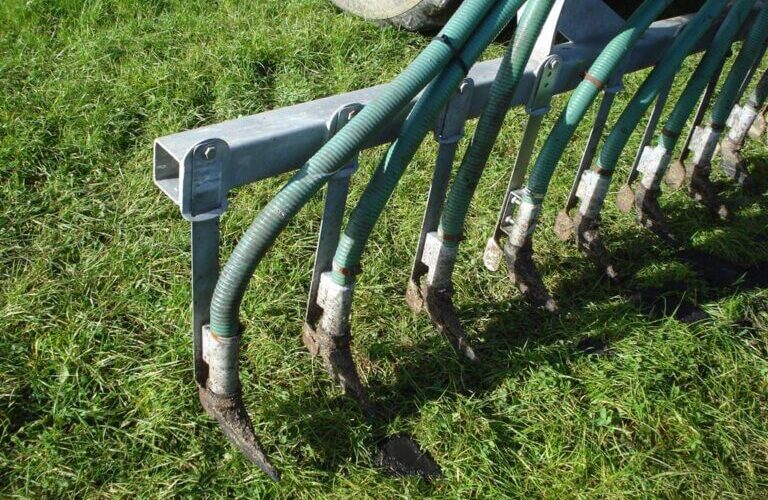
Where possible, methods such as trailing shoe or dribble bar can improve nitrogen use efficiency and reduce nutrient losses, particularly to the water environment. - Include slurry in your nutrient management plan
Accounting for slurry nutrients alongside fertiliser helps avoid over-application, saves money on bagged fertiliser and supports compliance with environmental regulations.
What’s in your slurry tank? Unlocking the nutrient value on your farm
With fertiliser prices remaining volatile and input costs continuing to challenge farm margins, it has never been more important to make full use of the nutrients already available on farm. Slurry is often viewed as a waste product that simply needs to be managed, spread and forgotten about. But it is a valuable fertiliser resource containing nitrogen (N), phosphate (P) and potash (K) that can replace a significant proportion of purchased fertiliser when used carefully and with forward-thinking.
- Taking the time to understand the nutrient value of slurry can help farmers make better fertiliser decisions, reduce input costs and protect water quality at the same time.
- Livestock slurry contains all three key crop nutrients. Typical cattle slurry at around 6% dry matter contains approximately 2.6 kg of nitrogen, 1.2 kg of phosphate (P₂O₅) and 3.2 kg of potash (K₂O) per cubic metre.
- When applied at a common rate of around 30 m³/hectare (approximately 2,700 gallons/acre), this could supply around 78 kg N, 36 kg P₂O₅ and 96 kg K₂O per hectare.
- For many grassland systems, that is a significant nutrient contribution. Potash in particular is supplied in large quantities from slurry and is especially important for silage crops where offtake can be high.
This highlights an important point: slurry should be managed as a fertiliser resource, not a waste product.
The case for slurry testing
One of the most effective ways to improve nutrient management is to sample and analyse slurry regularly. A simple laboratory analysis will typically provide information on:
- Dry matter content
- Total nitrogen
- Phosphate and potash
- Additional nutrients such as sulphur and trace elements
This information allows slurry to be used more precisely within a nutrient management plan, turning what is often viewed as a box ticking exercise, to a meaningful, living document.
Target slurry where it is needed most
Soil testing results should also be considered alongside slurry analysis. Recent recipients of support under the Preparing for Sustainable Farming (PSF) scheme can put those soil results to good use, again, turning what could be viewed as a box ticking compliance exercise into a valuable information source and something that will impact practices on the ground.
- Fields with lower phosphate and potash indices are often the best candidates for slurry applications. Targeting these areas can help build soil fertility while reducing the need for purchased fertiliser.
- Where soil nutrient levels are already high, it may be more appropriate to limit applications to avoid nutrient surpluses.
Turning slurry into a farm asset
Slurry management is often discussed in terms of storage requirements, spreading restrictions or environmental risks. While these issues are important, it is equally important to recognise the positive value slurry brings to the farm business. Good slurry management, particularly at times of uncertainty can limit the financial pressure on farm businesses, maintain good practice and protect the environment – why choose when you can have it all?