
Sustainable Management of Waterways
Rachel Smillie, Senior Land Management Advisor for Forth Rivers Trust and Partner in The Upper Forth Farmer and Land Manager Network.
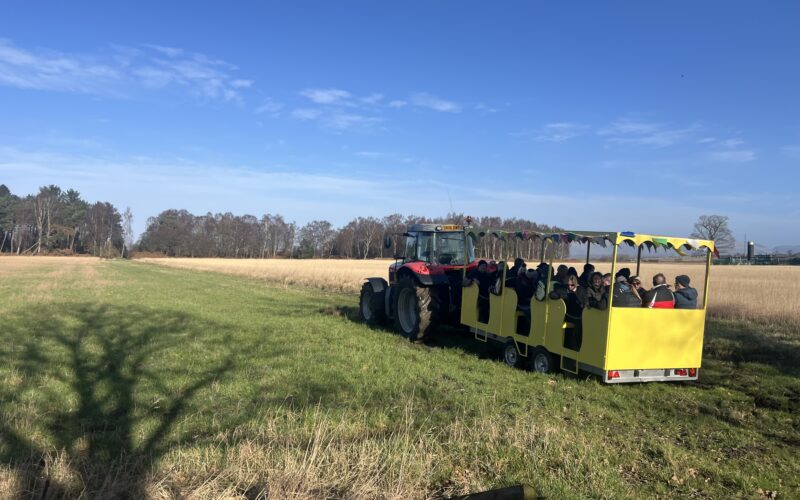
In early March, the Upper Forth Farmer and Land Manager Network (UFN) collaborated with Farming and Water Scotland to host a practical demonstration event on sustainable waterway management. The aim was to share knowledge on effective ditch and drainage maintenance and to give farmers clearer guidance on what actions they can take under current regulations.
The event was held on a farm located in the low-lying Carselands of the River Forth. Attendees began the day by hearing from the host farmer about the farm’s management and the ongoing challenges linked to water and soil. Seeing the landscape first-hand helped the group follow how water moves across fields and discuss realistic management options with Farming and Water Scotland.
Understanding the Drainage Network
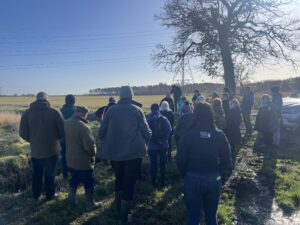 The first stop examined the farm’s network of field drains and ditches. On land this flat and low lying, artificial drainage is crucial for removing excess water from the soil and directing it into ditches that help move water down the catchment. Well-maintained ditches protect productive land and ensure crop yields are not compromised by prolonged wet conditions.
However, this ditch system receives unusually high levels of sediment. Upstream lies a recently closed commercial peatland site where bare peat is contributing sediment to runoff. Without intervention, high sediment levels lead to field-edge erosion, reduced ditch capacity, and waterlogged fields.
Looking beyond the immediate ditch, the group discussed both upstream and downstream influences. Participants considered how sediment from the peatland site was affecting the farm and how water leaving the farm could in turn affect neighbouring land further down the catchment. These discussions highlighted the importance of managing water at a catchment scale.
The host farmer also described long-standing cooperation among neighbouring farms. Shared ditches are often jointly maintained, helping keep water moving freely and preventing flooding or drying issues downstream. However, poorly maintained, timed or poorly executed ditch clearing can increase sediment entering watercourses and affect water quality.
Clarifying the Rules
Despite the importance of drainage maintenance, many farmers remain uncertain about what they can and cannot do without authorisation. This uncertainty was a key motivation for the event. Pete Wright from SEPA explained that a hierarchical approach determines whether maintenance requires contacting SEPA, depending on factors such as ditch width and if it has been historically modified. He also emphasised that in most situations, something can always be done, and just to ask if unsure.
At this site, the ditch fell within routine maintenance rules as it was less than 1 meter wide and had been artificially straightened, meaning sediment could be removed without contacting SEPA. However, responsible practice remains essential. Timing work to avoid sensitive periods for wildlife and using simple mitigation measures such as straw bales or silt fences helps prevent pollution and protect habitat. Attendees were encouraged to consult Farming and Water Scotland’s ‘Know the Rules’ factsheets for further guidance.
Reducing Sediment at the Source
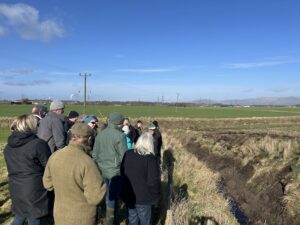 The second site visit focused on options for reducing sediment entering ditches in the first place. The group discussed measures such as reshaping steep banks, widening field margins to intercept runoff, and encouraging vegetation on bare banks to stabilise soil. These actions can reduce the need for frequent ditch clearing while improving soil health and water quality.
Alex Pirie, SAC Consulting, highlighted the various options under Agri-Environment Climate Scheme (AECS) to fund some of the options. A lot of information to list here, so see his article from the last FWS Newsletter.
Although not explored in depth on the day, the group also recognised potential collaboration with the neighbouring peatland site. Restoring bare peat would tackle sediment issues at their source, benefiting both agricultural productivity, reduce time and effort in ditch maintenance and benefit the wider catchment.
About the Upper Forth Network
 This was The Upper Forth Network’s first demonstration site visit. Events like this play a vital role in sharing practical knowledge, improving understanding of regulations, and strengthening farm‑to‑farm learning that supports better soil, water, and catchment management.
The Upper Forth Farmer and Land Manager Network is a collaboration between Forth Rivers Trust, Carse of Stirling Partnership, Glasgow Caledonian University, and Propagate. It supports farmers and land managers in addressing shared catchment challenges and promoting resilient soil and water management through demonstration events, advisory visits, and social gatherings. More information is available at https://upperforthnetwork.org/.
Further information
If you are interested in learning more about what you can and can’t do with regard to ditches please watch the video below for more information.
Related resources
Top Tips: Getting the most value from your slurry
Alex Pirie, SAC Consulting
Test before you spread Slurry nutrient content can vary widely between farms and even between…
River basin management and nature-based solutions
Fiona Salter and Lorna Cole
River basin management plans (RBMPs) provide a framework to address environmental objectives outlined in Water…
Silage Pit Preparation & Maintenance
Pete Wright, SEPA
With silage season approaching, it is essential to ensure your silage pit is in good…