
Riverbank restoration – where to start
Alex Pirie, SAC Consulting
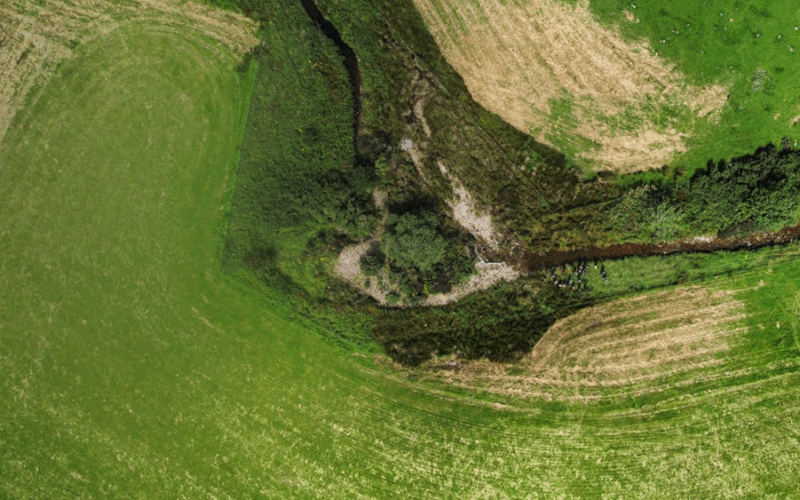
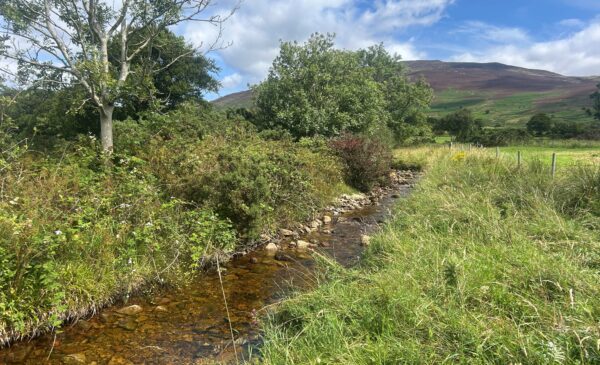
Last year, Farming and Water Scotland attended a meeting facilitated through Scotland’s Farm Advisory Service (FAS). The meeting was part of the wider FAS Connect initiative and was focused on riverbank restoration and the promotion of sustainable management practices in the farmed water environment. During the meeting, the hosts explained that they felt they were losing productive parts of their adjacent silage field and were seeking insights and ideas around what to do to retain their field, protect the current watercourse and enhance the area for nature.
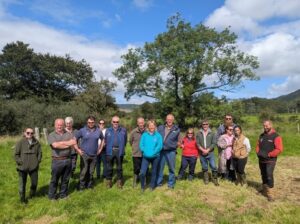
The group was joined by a member of the local Ayrshire Rivers Trust who spoke about the water environment and the work of the trust to safeguard it for farmers, the public and species of particular significance – notably Atlantic salmon, European eel and brown trout. The session involved an evaluation of the habitat in its current condition, including an analysis of why the river is shifting and its overall hydrology.
| Restoration or Enhancement Options Available | Rationale |
| Do nothing | Watercourses are live and dynamic environments; they will always change. What is happening in this instance is that the river wants to take the path of least resistance and in doing so heavy flow is eroding the banks as it cuts a new pathway. |
| Implement green engineering of the riverbank | Accepting that fast flow is responsible for the changes in the watercourse, the farm could look to soften the impact of the flow and mitigate against the erosion, this can be done with a combination of hard or soft landscaping, including willow spilling, funded under AECS. |
| Extend the existing water margin | The watercourse is fenced off already, excluding livestock access to the waterbody, but it is narrow, in some places as little as 2 m wide. Capital support may be available to increase the width of the margin and receive management payments for active management of these new areas. The host farmer had already reflected on the reduced output for the land in proximity to the watercourse anyway. |
| Creation of a pond(s) | Figure 2 shows immediately above an area of rush pasture where the farmer has proposed a creation of a pond. Ponds can facilitate landscape works that could benefit the wider environment, helping to contain overflow when the river is in spate. |
In best condition, water margins operate as wide, continuous transition zones between farmland and water rather than narrow strips of short grass. They are sufficiently wide to intercept runoff, slow overland flow and trap sediment and nutrients before they reach watercourses, ponds or ditches. Continuity is important: gaps where cultivation, spraying or trampling reach the bank significantly reduce effectiveness for both water quality and wildlife.
Vegetation within best-condition margins is dense and structurally varied. Grasses, sedges, rushes and tall herbs form a physical filter, while tussocks and patches of taller growth provide habitat for insects, birds and small mammals. These margins are not intensively “tidied”; some seasonal management may be used to prevent scrub dominance or remove accumulated nutrients, but refuge areas are always left intact. This acceptance of a slightly “messier” appearance is a key shift away from purely cosmetic land management towards functional nature recovery.
Trees and scrub, where appropriate, add further value by creating a mosaic of shaded and open sections along watercourses. Strategic shade helps regulate water temperatures and reduces climate stress on aquatic life, while retaining open areas prevents excessive shading and maintains plant diversity. The emphasis is on balance rather than uniformity, recognising that different species and processes require different conditions.
Finally, best-condition margins are characterised by minimal external pressures. Fertiliser, slurry and pesticide inputs are kept well back from the water’s edge, livestock access is fenced or tightly controlled, and invasive species are absent or actively managed. In this state, water margins deliver multiple outcomes simultaneously:
- improved biodiversity,
- better water quality,
- reduced erosion,
- greater resilience to climate change.
These multifunctional benefits sit squarely at the heart of Scotland’s 2045 vision for biodiversity, where productive land use and nature recovery are no longer treated as competing objectives but as complementary ones.
Ponds
A pond in good condition is one that functions as a stable, low-nutrient freshwater habitat rather than a collection point for runoff. The water is generally clear, without persistent algal blooms, strong smells or obvious enrichment from fertiliser, slurry or yard drainage. Some seasonal change is natural, but the pond is not chronically turbid or dominated by floating algae. This reflects the wider 2045 objective of improving freshwater condition and resilience to climate and nutrient pressures.
Structurally, a good pond has variety. Gently sloping margins, shallow shelves and areas of deeper water which create a range of conditions that support invertebrates, amphibians and aquatic plants at different life stages. Banks are stable and vegetated rather than steep or eroding, and hard engineering is minimal. This physical diversity increases ecological resilience, allowing ponds to cope better with droughts, intense rainfall and temperature extremes, all of which are expected to increase under climate change.
Vegetation in a good-condition pond is diverse and largely native, with a balance between open water and plant cover. Marginal, emergent and (where appropriate) submerged plants are all present, but no single aggressive species dominates the system. This diversity underpins food webs and provides breeding, shelter and feeding opportunities for a wide range of species. Importantly, invasive non-native species are absent or actively controlled, as they undermine both biodiversity value and long-term management outcomes.
Management pressure around a healthy pond is low. Livestock access is excluded or carefully controlled to prevent poaching and direct nutrient inputs, and the pond is buffered from surrounding land use by vegetated margins. Interventions such as desilting are infrequent and targeted rather than routine, recognising that ponds are dynamic systems and that wholesale disturbance can set biodiversity back rather than improve it. In this state, ponds function as small but important biodiversity “nodes” within wider farmed landscapes, contributing to the connected nature networks envisaged for 2045.
Related resources
Key environmental considerations when poultry farming
Stephen Field, SEPA
Whether you are already a poultry farmer or thinking of becoming one, there are key…
Importing organic fertilisers onto your farm -what do you need to consider?
Stephen Field, SEPA
Farmers and businesses receiving materials to be spread on their land have a duty to…
Water Environment – Agri-Environment Climate Scheme (AECS)
Alex Pirie, SAC Consulting
In Autumn 2025 Minister Jim Fairlie announced the return of the Agri-Environment Climate Scheme (AECS),…