
River basin management and nature-based solutions
Fiona Salter and Lorna Cole
River basin management plans (RBMPs) provide a framework to address environmental objectives outlined in Water Framework Directive, which the Scottish Government is legally bound to implement to protect and improve the water environment. RBMPs set out objectives, measures and practical actions required for river basins to achieve these goals, including many actions relevant to agriculture. In Scotland we are currently in our 3rd management planning cycle running from 2021-2027 with the next due 2027-2033.
RBMPs establish a framework to protect and improve the water environment through identifying pressures, actions to alleviate these pressures and means of monitoring change. In our current changing climate, a more integrated approach to RBMPs could make a real positive difference. This has been considered in the new Centre for Expertise for Waters (CREW) publication -Natural Capital and River Basin Management Planning Protecting and Improving Scotland’s Water Environment.
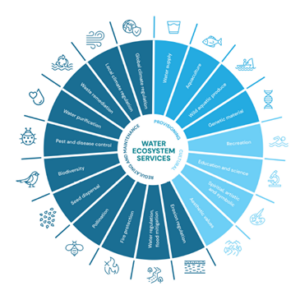 The water environment within Scotland provides key benefits (i.e. ecosystem services) which our society and economy strongly depend on (Figure 1[1]). The provisioning of these services is strongly impacted by the natural resources (e.g. the soils, habitats and their condition) present within a catchment. However, historically these natural resources were undervalued in decision-making resulting in the degradation of the ecosystem services they provide. Protecting our natural resources and improving their condition will, and can, improve the water environment, and the essential benefits it provides. But where to start? What are the most important actions we can undertake to improve our water quality and quantity, to support businesses who are critically dependent on the services our water environment provides?
Figure 1 Diversity of ecosystem services provided by the water environment. Source CREW
The answer to this question is not simple, but there are options available that will suit most farming systems; options that will improve the water environment, make financial sense for the business, and build resilience into the system. The degradation of natural resources directly impacts on agricultural production reducing profit margins. Degraded, compacted soils not only reduce agricultural yields, but can also increase operational costs including fuel costs when working fields (Table 1). Reducing compaction will benefit yields, reduce fuel costs, whilst also provide a wide range of additional benefits. Healthy soils, have higher capacity to uptake and hold water which reduces the impact of drought and flooding, furthermore in reducing surface water runoff they protect soils from erosion mitigating diffuse pollution. Addressing soil compaction may seem trivial, but it can have a huge impact on the wider system, influencing how water is retained and utilised on your land, and ultimately improving efficiency and saving money.
| Crop | Additional cost (£/ha)a | ||
| Sandy topsoils | Silty topsoils | Clay topsoils | |
| Potatoes | 70 | 144 | 209 |
| Cereals | 15 – 19 | 32 – 38 | 46 – 56 |
| Oilseed rape | 20 | 41 | 60 |
| Peas and beans | 18 | 38 | 55 |
a assumes a fuel cost of £0.98/litre
Table 1 Increased fuel cost due to compaction by crop and soil type SOURCE CREW
Catchment planning
Historically we have managed land within land ownership boundaries, however, water doesn’t recognise such boundaries. We therefore should start to consider more cooperative catchment—scale approaches to water management that transcend farm boundaries? Moving to an approach that ensures the most appropriate feature in the best location is likely to have the most sustainable and financially viable returns. An integrated, catchment wide approach to river-basin management planning that engages with local stakeholders from the outset is thus likely to have the greatest benefits to the water environment and beyond.
 Nature based solutions
Nature-based solutions (NbS) are actions targeted to protect, enhance and restore natural resources to increase the ecosystem services they provide to society. A wide and varied range of NbS can help to protect and restore our water resources and the best action to implement is often context specific. Choosing the best NbS will depend on the natural resources in question, the condition and management of these resources, alongside the challenges faced within a specific river catchment. For example, in catchments with high flood risks, restoring peatlands and floodplains provide natural flood management alleviating risk. However, in productive arable catchments these NbS may not be feasible or viable to implement. In such catchments, NbS that increase the ability of agricultural soils to uptake and hold water (e.g. controlled traffic farming to alleviate compaction and incorporating soil organic matter) will be more sustainable.
NbS targeted to improve water quality or availability, typically provide a wide range of wider benefits. For example, hedgerows not only intercept sediments protecting rivers from pollutants, but also capture and store carbon, provide livestock with shelter and shade, and provide habitat and resources for wildlife.
Spatially targeting NbS within a catchment will further increase the benefits provided (the right NbS in the right place). For example, cover crops will have the greatest impact if placed on steeply sloped hills, hedgerows will provide greater benefits if located where they intercept water flow pathways and wetlands will be most beneficial when situated in areas that are naturally prone to flooding. Local knowledge is therefore crucial to identify the most strategic locations for specific interventions.
Funding Nature-based solutions
Recognising the wide range of benefits to society that NbS provide, there are several government-funded schemes that financially incentivise implementation. These include the Agri-Environment Climate Scheme, Forestry Grant Scheme and Peatland Action. In addition to public funding, a range of emerging natural capital markets are likely to become an increasingly important source of private investment, helping to bolster declines in public funding. Currently, the most well-developed mechanisms are the Woodland Carbon Code and Peatland Code. While these codes are relatively limited in scope, additional frameworks are beginning to emerge, including the UK Carbon Code of Conduct, Hedgerow Carbon Code and Woodland Water Code. Furthermore, as large transnational cooperations seek to reduce risks associated with deteriorated soils, waters and natural resources, we are seeing growing interest and investment in NbS across the supply chain. This includes financially supporting regenerative agriculture from companies such as Nestlé and PepsiCo.
Landowners are at the heart of protecting and restoring our natural resources, and ensuring our water environment continues to provide the multitude of benefits that our society and economy depend on.
[1] Cole, L.J., McCarthy, J., McVittie, A., Buckingham, S., Barthelmess, V., Stevens, B., Audsley, R. 2026. Natural Capital and River Basin Management Planning Protecting and Improving Scotland’s Water Environment. Main report. CRW2024_04. Centre of Expertise for Waters (CREW).