
Water Environment – Agri-Environment Climate Scheme (AECS)
Alex Pirie, SAC Consulting
In Autumn 2025 Minister Jim Fairlie announced the return of the Agri-Environment Climate Scheme (AECS), and its continuation to 2030. This was news welcomed by farming and crofting businesses across the country. Since 2015 AECS has been the principal avenue to promote the uptake of nature friendly farming practices. Over the years this has included support for organic farming, slurry storage and public access, in addition to the standard environmental management options and capital items.
As we move towards a new support framework, making sure AECS remains able to respond to changing priorities is itself a top priority for policymakers.
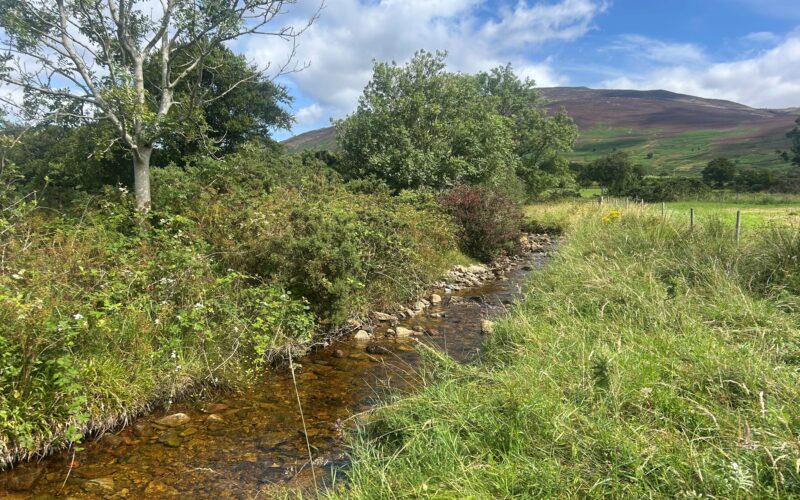
The water environment has always been an integral part of the farmed landscape, from ponds, lochs, rivers, streams to everything in between. These systems are increasingly being recognised for their positive contributions in terms of ecosystem services and resilience in the face of changing weather patterns – too wet and too dry.
Historically, recognition has taken the form of points towards pollution mitigation and the control management of semi-natural habitats. This has included a prohibition on fertiliser application, beneficial management in priority catchments and for priority species like the freshwater pearl mussel.
But from 2026, AECS will include a new point incentive to encourage the creation of new water margins and their extension across wider areas of land.
In addition to the existing points available for management beneficial to the water environment within predetermined priority catchments, an additional point will be awarded for newly created water margins in your application, if the width of the new margin is as follows:
- 6 m or more, along water courses less than 1.2 m wide (including 2 m strip required by GAEC)
- 12 m or more, along water courses between 1.2 m and 15 m wide (including 2 m strip required by GAEC)
- 20 m along watercourses greater than 15 m wide (18 m plus 2 m strip required by GAEC)
- 20 m around still water bodies (18 m plus 2 m strip required by GAEC)
| Application Type(s) | Application Window Date(s) |
| Agri-Environment applications | 23 February to 20 June 2026 |
| Organics applications | 23 February to 31 July 2026 |
| Stand-alone Irrigation Lagoon applications | 23 February to 20 June 2026 |
| Agri-environment combined with organics or irrigation lagoons in same application | 23 February to 20 June 2026 |
At £123.42 and £495.62 per hectare respectively, water margins have never been income heavy hitters within AECS contracts but there are many less tangible benefits from managed watercourses. Actively managed watercourses act as important buffers, protecting against soil loss and enrichment of our waterways with fertilisers, or prevent pollution, a recognised driver of nature decline. These areas are often the less productive areas of the farm, places where the cost benefit analysis from cultivating or improving just doesn’t add up.
Not all businesses are eligible for the management options related to water margin management, though they are widely available. Prospective applicants should review their eligible options with the Rural Payments updated spatial targeting tool. Using the tool will provide a reliable list of available options and provide guidance on how to pursue an endorsement if required.
Those hopeful applicants looking to incorporate water margins into their AECS applications must complete a Water Margin Management Summary Table regardless of whether the management option is the arable or grassland version.
Water margins are often areas associated with cross compliance breaches. Livestock access can accelerate poaching and run-off, and in the summer, soils are more vulnerable to erosion from cattle and sheep entering burns and streams. Capital funding remains available for businesses looking for extra support to fence off newly created margins and replace derelict fences under specific circumstances.
Related resources
Key environmental considerations when poultry farming
Stephen Field, SEPA
Whether you are already a poultry farmer or thinking of becoming one, there are key…
Importing organic fertilisers onto your farm -what do you need to consider?
Stephen Field, SEPA
Farmers and businesses receiving materials to be spread on their land have a duty to…

Riverbank restoration – where to start
Alex Pirie, SAC Consulting
Last year, Farming and Water Scotland attended a meeting facilitated through Scotland’s Farm Advisory Service…